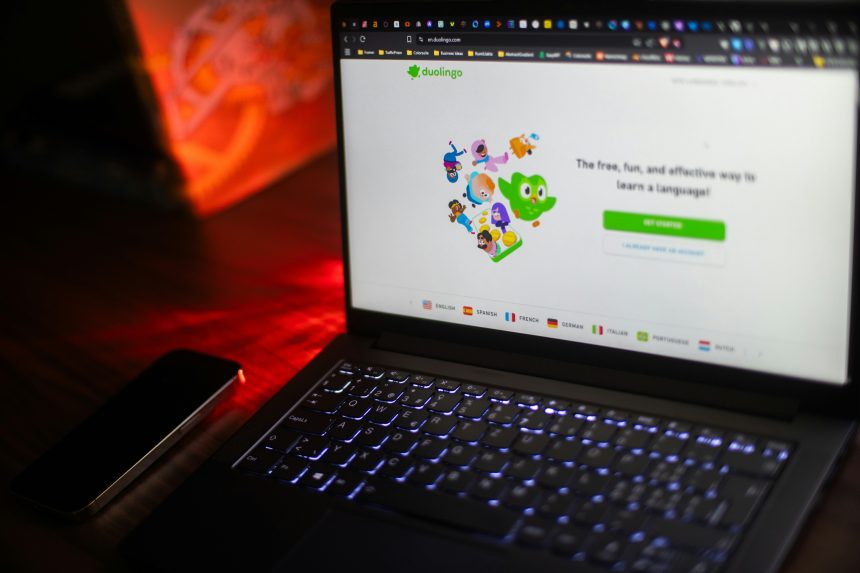
Duolingo’s (NASDAQ:DUOL) stock dropped more than 10 percent on the 11th of February after T-Mobile made an explosive announcement which threatens their core business.
T-Mobile announced a real-time, network-integrated artificial intelligence translation service (AI) on Wednesday. This has caused DUOL app investors to reassess their value.
Duolingo’s stock has dropped by 40% in the past year.
Duolingo Stock at Risk from T-Mobile Solution
T-Mobile has launched “Live Translation” which allows users to translate their phone calls “in real-time”, in 50+ different languages.
This new language learning solution is unlike Duolingo which takes years to “streak” through the program and requires a lot of effort.
T-Mobile’s embedding of agentic artificial Intelligence directly in the 5G Advanced signal has effectively commodityized language learning.
T-Mobile has significantly reduced the incentives to sign up for Duolingo Max with its new offer.
The app is no longer a must-have for many users. It has become an optional hobby. This makes DUOL stocks less appealing to buy in 2026.
AI can be a double edged sword for DUOL share prices
Duolingo Inc is concerned about T-Mobile’s launch, as its foundations are already showing signs of cracks.
Goldman Sachs, Wells Fargo and other investment firms believe that this trend is unlikely to be reversed anytime soon.
Analysts have expressed concern about “challenging comparisions” in their reports. They noted that the hypergrowth of pandemic era is now firmly behind us.
Wall Street’s main concern is that DUOL faces a double-edged “sword” in the form of AI.
Duolingo’s lessons are powered by AI, but the same technology is used by competitors such as Google and OpenAI, who can create free, hyper-efficient alternatives without the need of a learning curriculum.
The “AI-parity risk” suggests that the company’s exclusive content might no longer command premium prices, which raises questions as to whether Duolingo can make a comeback by 2026.
Duolingo’s future is based on the data available.
While DUOL’s shares look attractive at a P/S multiple of only “6”, the technical view suggests that a short-term recovery is unlikely.
Duolingo’s relative strength (14-days) is in the oversold zone and the key moving averages are sitting above the stock price. It appears that the company is in a downtrend.
The education technology firm has been losing exposure because of this dwindling technical and fundamental overview.
Options traders also warn that Duolingo Inc. will continue to fall. Barchart reports that the current lower price for contracts ending mid-May is $70, which indicates a potential 30% drop over the next 3 months.
DUOL, in conclusion, is not priced like a tech giant, but rather as a legacy edtech company that’s struggling to protect its borders from the AI giants.
The post Duolingo Stock is Crashing and T-Mobile Could Be to Blame may be updated as new information becomes available