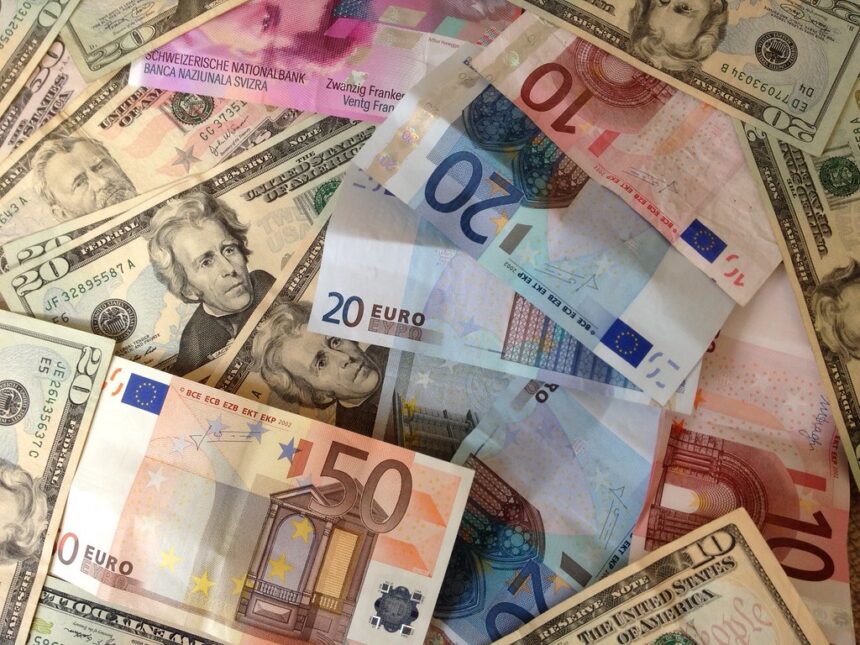
It is now the lowest it has been since 2023.
It is often referred to as a warning in the headlines. Trade wars, political turmoil, and deficits have caused yet another casualty. What if this is only a part of the picture?
What if it’s not a mistake but part of a plan that the dollar is weak? If this was less about mistakes and more about strategy, what if it wasn’t a mistake? A deliberate change in the way America plays global games?
You start to notice something else when you examine the policy, timing and ripple effects. It’s more deliberate.
What is the reason for this sudden drop in dollar value?
Bloomberg’s Dollar Spot Index shows that the US dollar is down more than 8 percent since January.
The stock fell another 0.8% Friday after Trump announced he would impose tariffs of 50% on imports from the European Union and 25% on Apple Products.
The currency market reacted by selling off, and traders shifted to the New Zealand dollar or Australian dollar, which both rose more than 1%.
Normal, the dollar will tend to rise during times of global unrest. The dollar acts as a haven of safety. The opposite has happened this time.
The dollar’s status as a safe asset is no longer regarded by investors, who are now beginning to question whether it still merits that title.
Most major currencies are stronger against the US dollar since the beginning of this year.
The change can also be seen in the futures market. Reports claim that short positions against the dollar are now at $16.5 billion. This figure has steadily risen for several weeks.
Does this only concern tariffs?
Tariffs play a part in the story but are only a small spark. It’s the US direction that is more important.
Trump’s latest threats of tariffs were announced one day after the House Republicans approved a second round of tax reductions.
Both actions are in opposition to each other. Deficit increases due to tax cuts. Tariffs raise prices.
They create an uncertainty the markets do not like.
According to estimates reviewed by Congress, the proposed tax package may add up to $700 billion annually to the federal budget deficit.
This would add an extra $3.7 trillion to the debt over a 10-year period.
Tax cuts offer only limited benefits. According to the Joint Committee on Taxation, they will only increase GDP in long term by 0.03%.
The crux of it is that. Economic payoffs are small. Costs are high.
The political instability surrounding these policies also makes it difficult to value them.
Investors have begun to take all that into account, and are not pleased with what they find.
What do the markets tell us?
Bond market warnings are most prominent. The demand for Treasury bonds with long maturities is waning.
Recent 20-year bonds auctions struggled to find buyers. Investors are demanding higher yields for US debt.
Moody’s has downgraded its credit outlook for the US last week. It cited structural deficits as well as the possibility of an increase in borrowing.
They weren’t concerned about the amount of deficit. The problem was that there wasn’t a solution.
The US equity market also fell again. On Friday, the S&P 500 dropped by nearly 1%.
Walmart and other companies warn that they might need to increase prices in order to compensate for new tariffs.
The Federal Reserve is in a tough position. The Federal Reserve may be in a difficult position if inflation increases due to increased import costs but the growth rate slows down because of uncertainty.
If firms do not know how their policy will be in one week, then they cease to make long-term plans.
Is this intentional?
Some economists are beginning to question whether the decline of the dollar is not only a failure in policy, but also part of a plan.
Trump’s fiscal and trade actions may seem aggressive on the surface but could have hidden goals.
According to one theory, inflation can be used as a debt-relief tool.
The traditional way of reducing deficits through tax increases or spending cuts, which is usually the case, seems politically impossible. Inflation reduces that debt’s real value.
Deutsche Bank estimated recently that, despite being extreme, a drop of 40% in the US dollar could theoretically eliminate the US deficit.
In real terms, a cheaper dollar will make debts cheaper. This is especially true if inflation and wages are rising.
Trump may be more interested in inflation than austerity, judging by his apparent willingness to accept a weaker dollar and past threats of firing Fed chair Jerome Powell if he kept rates high.
This may explain policy contradictions such as the fact that the Fed is under pressure to not raise interest rates, while at the same time cutting taxes and raising tariffs.
This is not a plan for growth. Soft default is the design without having to ever say so out loud.
One more extreme possibility is the US deliberately moving away from its dollar dominance.
Trump and others in his inner circle view reserve currency status as not a privilege but a burden.
The US is forced to maintain persistent trade deficits and backstop global liquidity as well as act the lender of the last resort for many other countries.
Trump does not want America to be the leader of the world. Trump wants to see the US win bilateral agreements, control their supply chains and stop subsidizing global orders.
It may even be that the purpose of letting the dollar drop, breaking up global alliances and alienating the multilateral institutions is not to cause side effects, but rather, they are the intended result.
This could mark the start of a new multipolar world, where the dollar is still important but not dominant.
This would reduce America’s exposure to the world, decrease foreign dependence, and increase flexibility in domestic policy.
It is speculation, but it becomes more plausible when you consider recent events.
Germany has rearmed. The EU has threatened retaliation. BRICS countries are exploring alternative currencies to the US dollar.
From Japan to France and other US allies are preparing for a future in which the dollar will no longer be the anchor.
Trump’s agenda, whether planned or unplanned, is forcing this conversation quicker than expected.
This article What if the weak US Dollar was planned all along? This post may change as new information becomes available