In 2015, Chinese President Xi Jinping used the term “Thucydides Trap” in Seattle before an audience that included former Secretary of State Henry Kissinger.
“There is no such thing as the so-called Thucydides Trap in the world. But should major countries time and again make the mistakes of strategic miscalculation, they might create such traps for themselves,” Xi said ahead of a state dinner hosted by then-US President Barack Obama.
He used the phrase again in 2024 while meeting US President Joe Biden in Lima, Peru, on the sidelines of the 31st APEC Economic Leaders’ Meeting.
“The Thucydides Trap is not a historical inevitability. A new Cold War should not be fought and cannot be won. Containing China is unwise, unacceptable and bound to fail,” he said.
Xi revisited the term for a third time during the current US President Donald Trump’s recent visit to China.
Speaking before Trump at the Great Hall of the People, Xi said the world had reached a new crossroads.
“Can China and the United States overcome the ‘Thucydides Trap’ and establish a new paradigm for relations between great powers?” he asked.
For more than a decade, Xi Jinping and senior Chinese diplomats have invoked the concept, portraying it not as an unavoidable outcome but as a warning against strategic miscalculation.
What’s different this time is how Jinping used it, said Steve Bannon, a former Trump strategist and Peloponnesian War aficionado.
Bannon interpreted the remark as a threat directed at Donald Trump over Taiwan, warning that if the United States meddled in what China considers its internal affairs, it could lead to armed conflict.
“It’s extremely in your grill, especially when this is the opening statement,” Bannon said, as reported by Politico.
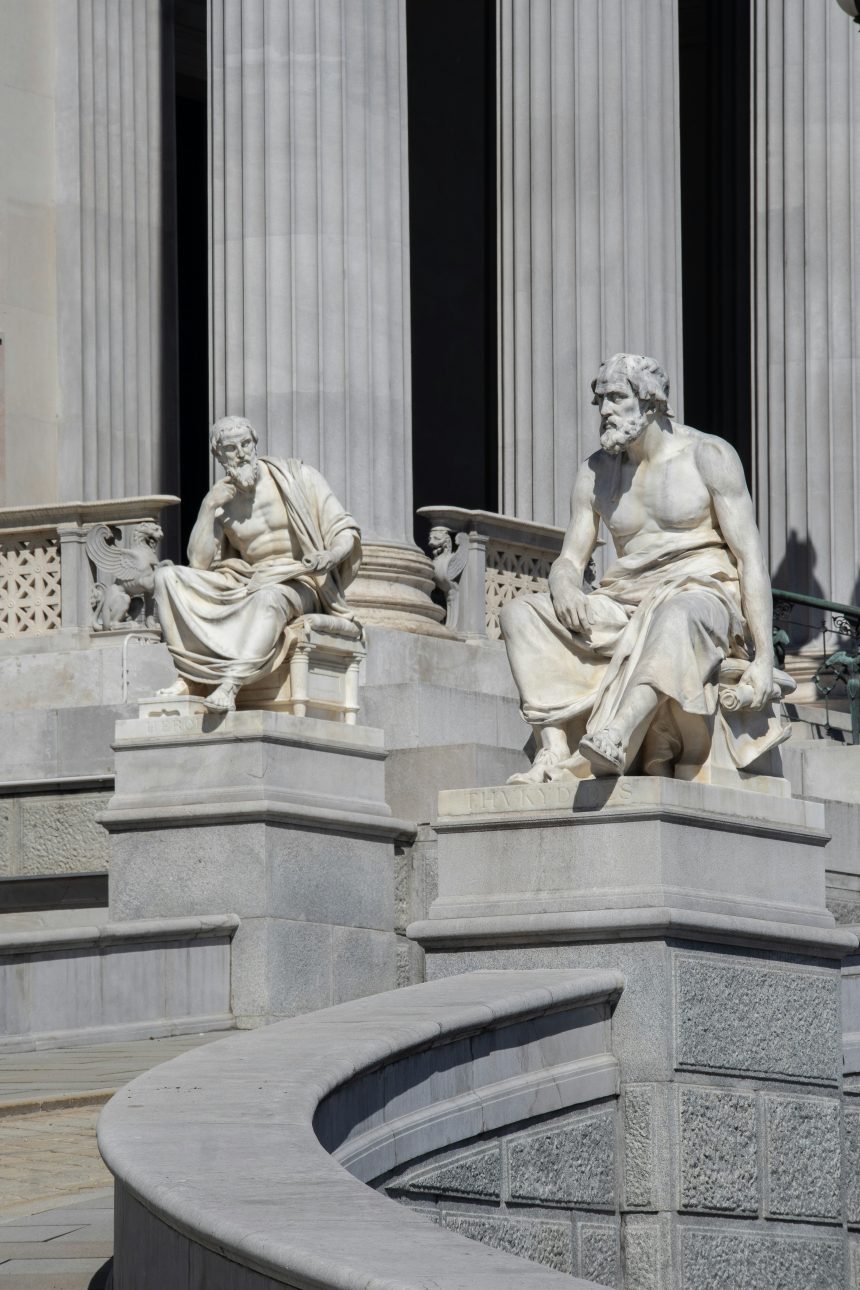
What is the Thucydides Trap?
Thucydides, the ancient Greek historian, chronicled the Peloponnesian War (431–404 BCE) between Athens and Sparta, attributing its causes to a variety of political, economic and strategic factors.
One of his most cited observations states:
“What made war inevitable was the growth of Athenian power and the fear which this caused in Sparta.”
Later, Graham Allison, Harvard’s Douglas Dillon Professor of Government, coined the term “Thucydides Trap” in his book Destined for War.
It refers to the precarious situation in which an ascending power threatens to displace an established one — a situation that historically has often led to war.
As China continues to rise and challenge the global leadership of the United States, Allison has said the idea feels more relevant than ever.
Writing for the Financial Times in 2012, Allison said that “the defining question about global order in the decades ahead will be: can China and the US escape Thucydides’s trap?”
Allison expanded on the “trap” idea further in his 2017 book Destined for War: Can America and China Escape Thucydides’s Trap?, which argued that the two countries were “on a collision course for war—unless both parties take difficult and painful actions to avert it.”
To demonstrate his theory, Professor Allison identified 16 instances in history in which a rising power threatened to displace a ruling one.
According to his tally, which is subjective, 12 of the 16 rivalries ended in conflict.
Observers have noted that Xi has used the term for years, but deploying the classical reference during Trump’s visit may have foreshadowed his position on Taiwan.
Xi’s statement on Taiwan and its implications
“The Taiwan question is the most important issue in China-US relations,” Xi said, of the self governing island that China claims as its own.
“If mishandled, the two nations could collide or even come into conflict, pushing the entire China-US relationship into a highly perilous situation,” he added.
“If it is handled properly, the bilateral relationship will enjoy overall stability. Otherwise, the two countries will have clashes and even conflicts, putting the entire relationship in great jeopardy,” a Chinese statement said.
Wen-Ti Sung, a non-resident fellow with the Atlantic Council’s Global China Hub, said Xi’s tone was “surprisingly firm for summit diplomacy”.
That was intended to signal to Trump that the “Taiwan issue remains the reddest of red lines” for Beijing.
Xi’s message was “get Taiwan right and we are friends; get Taiwan wrong and we might become foes before you know it”, Sung said in an analysis by The Guardian.
In Xi’s version of the analogy, an emboldened China is the Athens to an American Sparta.
Neither role is especially attractive: Athens lost the war, its empire and most of its influence. Sparta won, but its dominance among Greek city-states also waned after a few decades.
Reading between the lines
At a state banquet later that evening, Chinese President Xi Jinping had struck a more conciliatory tone, insisting that the United States and China could manage what many see as increasingly unavoidable strategic friction.
“Achieving the great rejuvenation of the Chinese nation and making America great again can totally go hand in hand … and advance the wellbeing of the whole world,” Xi said.
Responding on social media, US President Donald Trump said Xi had “very elegantly referred to the United States as perhaps being a declining nation”.
Of course, Trump added, that was not a reference to the US under his watch.
Trump further fuelled uncertainty on Friday when he declined to directly answer whether the United States would defend Taiwan in the event of a Chinese attack.
“That question was asked to me today,” Trump told reporters aboard Air Force One as he flew back to the United States following the two-day summit in Beijing.
“That question was asked to me today by President Xi. I said I don’t talk about that,” the president said.
Trump’s comments came after a reporter asked whether the US would defend Taiwan if China launched military action against the island.
“I don’t want to say that,” Trump replied.
“There’s only one person that knows that. You know who it is? Me. I’m the only person,” he said, before adding that Xi had posed the same question to him earlier in the day.
A White House readout of the meeting published later also omitted mention of the country.
Why the Taiwan question may have remain unanswered
Ahead of this week’s summit between the Chinese and US presidents, Taiwan was widely seen as the uneasy observer caught between the world’s two largest powers.
Analysts had suggested that Taipei feared the unpredictable and transactional nature of Donald Trump could lead him to reconsider Washington’s longstanding support for the self-ruled island democracy.
Commentators had speculated that the US president’s need for Beijing’s support in ending the ongoing war with Iran could pave the way for some form of a “grand bargain,” in which Washington might make concessions on its support for Taiwan.
But the tone of Xi’s remarks suggested that the Chinese leader “may not want to place Taiwan within that framework,” said Alexander Huang, chair of the Taiwan-based think tank Council on Strategic and Wargaming Studies, The Guardian said.
“Xi did not openly ask Trump to say or commit something on Taiwan. This is because Xi believes the Taiwan question should be handled strictly between [Taipei and Beijing]. Openly asking Trump for specific words or actions would give the impression that Taiwan is a bargaining chip up for trade,” Huang said.
Experts also said that Trump’s decision not to give a comprehensive reply on Taiwan would be him “reading the room” after Jinping’s stern statement.
Thucydides Trap resurfaces in global power debate
Xi Jinping is not the only leader to invoke Thucydides while challenging US hegemony.
In a widely praised speech delivered at World Economic Forum Annual Meeting in January, Canadian Prime Minister Mark Carney also opened with a reference to Thucydides, citing the Greek historian’s famous aphorism: “the strong do what they can, and the weak suffer what they must.”
Carney’s speech was framed as a call for middle powers to push back against a Trump administration that, he argued, was dismantling the rules-based international order.
Ryan Swan, a China-US relations expert at the Bonn International Centre for Conflict Studies in Germany, views Xi’s repeated use of the concept as part of a broader diplomatic effort by Beijing to present itself as a “responsible great power” capable of coexisting peacefully with the United States.
Since taking office in 2012, Xi has pushed for the United States to treat China as an equal and refrain from opposing Beijing in what it considers its sphere of influence — recognition that Chinese officials believe would help produce a more stable coexistence between the two powers.
“China views the Thucydides Trap not as a predictive model, as it has occasionally been used in Western circles, but as a threat that can and should be avoided,” Swan said in a The New York Times report.
This post The ‘Thucydides Trap’: why a 2,500-year-old war loomed over the Trump-Xi summit may be modified as updates unfold
Please note, this site provides content for entertainment purposes only and does not offer financial advice. Read more here