Donald Trump said on Friday that he recommends a tariff of 50% on imported goods from the European Union. He cited a lack progress in the trade negotiations with the 27 nation bloc.
Tariffs proposed by Washington would go into effect on 1 June, and represent a dramatic escalation of tensions between Washington DC and Brussels.
Trump wrote on the social media platform Truth Social that “the EU is very difficult to work with…our talks with them have no progress!”
It was announced less than 30 mins after Trump had threatened Apple to impose a 25% tax on iPhones, if it did not start manufacturing the devices in the United States.
Trump is pursuing a more aggressive approach to trade as his administration rushes to reach deals in time for existing tariff agreements that expire at the end of July.
Source : Truth Social
Brussels is awaiting the scheduled meeting between EU and US Trade Representatives
The European Commission refused to comment immediately, saying that it will wait for the result of an upcoming call scheduled between EU Trade Commissar Maros Sfcovic, and US Trade Rep Jamieson Greer at 15:00 GMT.
It is likely that the call will be very tense as Greer plans on informing Sefcovic of recent EU proposals which fall far short of US expectations.
Many in Brussels were surprised by the timing of Trump’s announcement.
Only a few weeks ago, the US agreed to give both sides 90 days to discuss “reciprocal tariffs”.
This truce was intended to stabilise markets after Trump’s “Liberation Day” announcement of April 2. The initial 20% tariff, later reduced to 10%, had already upset investors.
Exports from the EU to the US currently only have to pay the “baseline tariff”.
The shift from 50% to 25% would be a radical departure, and could provoke retaliatory actions in Europe.
Market response swift and negative
Trump’s remarks had immediate financial consequences.
Stoxx Europe 600 fell by 1.9%. Germany’s DAX fell by 2.3%. France’s CAC40 dropped by 2.8%. The UK’s FTSE 100 also lost 1.3%.
The hardest hit sectors were those most susceptible to the global volatility of trade.
Bank stocks have been heavily discounted, and Deutsche Bank and Societe Generale lost 6% and 5% respectively.
Unicredit, the Italian lender, is down by 4.2%.
Investors weighed the indirect risk to banks from an economic slowdown that could be triggered by tariffs.
The consumer cyclical sector and the luxury goods industry were also affected.
Swatch Group, the maker of Ray-Ban sunglasses EssilorLuxottica and Swatch Group were both down about 5%.
The bond market, which is a safe haven in times of uncertainty, has seen an increase in demand.
The yield on Germany’s 10-year bonds fell by 8 basis points, to 2.56 percent, as well as yields for French, Italian and Swiss debt.
The bond yields are inversely related to the prices. This means that investors moved their money from riskier assets into more secure ones.
Economic experts warn about stagflation risk
Chicago Federal Reserve president Austan Goolsbee commented on the possible consequences of high tariffs.
The tariffs we had in the past 90 years were already at the maximum rate. Going to 50% represents a different magnitude.
Goolsbee, speaking on CNBC ‘s Squawk Box warned that tariffs would create a stagflationary scenario, increasing costs of production and decreasing output while also raising prices for consumers.
He added, “That is the worst possible situation for the Central Bank.”
In 2022 the EU became the world’s second largest buyer of US products, with imports of nearly $351 billion.
Tariffs of 50% could have a severe impact on transatlantic trade and cause multinational companies to lose confidence in open channels.
Trump’s strategy is still unclear
Trump’s administration has been in negotiations with more than a dozen countries in order to negotiate new trade agreements before the automatic tariff resets begin in early July.
Foreign officials, however, have voiced concern about Washington’s unpredictability, stressing that it is difficult to make concessions when the tariffs are reimposed at any time.
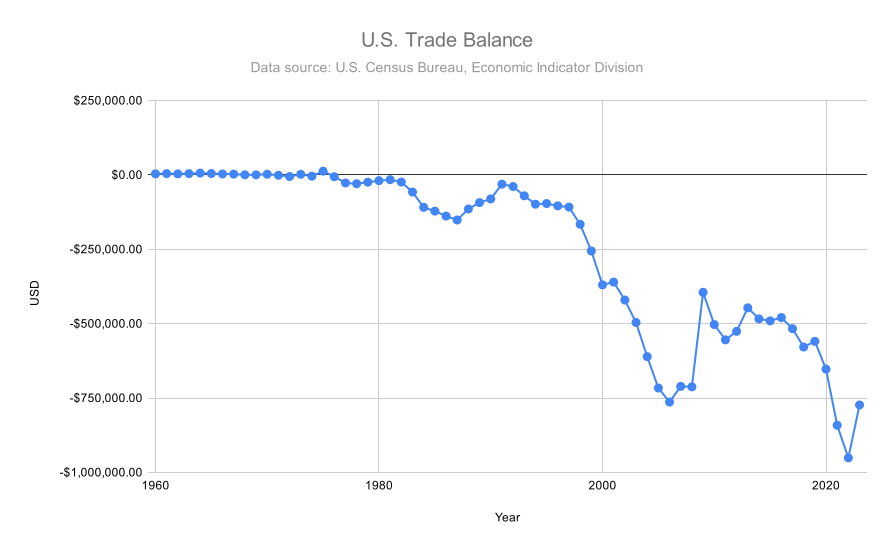
Trump has long claimed that European countries benefit from the United States’ trade in a disproportionate way.
The president’s push for “reciprocal tariffs” aims to harmonize duty rates. However, critics claim that such measures could spark full-blown wars of trade and undermine global supply chains.
The proposed tariff of 50% is set to take effect in less than two weeks. Attention now shifts towards upcoming trade discussions between US officials and EU officials.
If two major economic blocks cannot find a common ground, the gap between them could grow.
Post European stocks drop as Trump proposes a 50% tariff on EU Imports; Says talks with them “going nowhere” may be updated as new developments unfold
This site is for entertainment only. Click here to read more