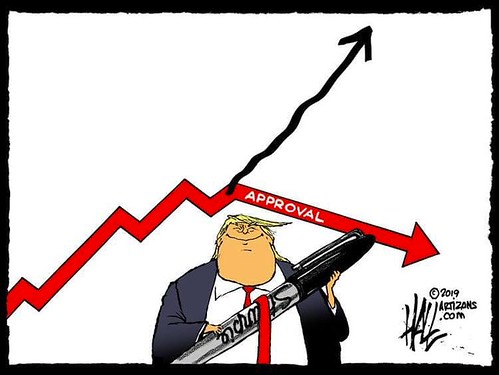
After 120 days in his second term as president, President Trump’s approval ratings have flipped upside down.
The initial wave of momentum in politics has now been replaced by a gradual erosion of support from the public.
All indicators, including new polling results, consumer sentiment indexes and economic indicators, point to the same conclusion.
Americans no longer believe that Trump will deliver on his promises regarding the economy, foreign policy, and trade.
He is losing his support, his policy divisions are spreading to his base and the confidence of his countrymen has fallen.
Is Trump losing the Room?
Trump’s approval rate is now between 42 and 43%, according to most of the major polls. His disapproval rating averages around 52-54%.
Gallup reports that his approval rating at the moment is 43 percent, which is slightly more than his average during his first tenure, but lower than other presidents in post-war history.
It has dropped dramatically. Trump’s net rating has dropped by 14 points, according to the Economist/YouGov tracking.
Reuters/Ipsos reported his lowest approval rating yet for a second term, 42%.
This drop occurs across all demographics. In just two months, Trump’s favorability dropped from 91% among 2024 Trump supporters to 85%.
Pew polls and New York Times/Siena surveys also reveal a growing unhappiness with Trump, not only with his policies but even with the way he leads. Over half of the voters described his presidency as chaos.
Trump is now being referred to as “scary by 36% of Republicans.
Tariffs have broken something
On April 2, Trump announced sweeping tariffs against nearly all US trading partner countries. The tariffs, initially dubbed “Liberation Day,” sparked market turmoil and consumer outrage.
Ten days later Trump reversed the majority of his decisions. The damage had been done.
The University of Michigan Consumer Sentiment Index fell from 52.2 to 50.8 between April and May. The University of Michigan’s Consumer Sentiment Index fell to 52.2 in April, then further dropped to 50.8 in May.
This is the lowest reading recorded.
The inflation expectation for the year ahead has risen to 7,3%, its highest level since 1981. All income groups of consumers reported a decline in personal finances as well as job uncertainty.
Two-thirds now of Americans expect the unemployment rate to increase for the first time in 2009.
This time, the universality of the response is what’s new.
Consumer confidence in 2022 was low but rich households were optimistic and continued to spend.
Even high-income Americans have started to turn negative. Joanne Hsu said that this was the first time high-income Americans have reacted as negatively as those with lower income.
Tariffs were cited as the primary concern by 75% of respondents in May. This is up from only 60% in April.
This issue has become more concrete. Tariffs are seen as the direct cause of higher prices and economic instabilities.
They don’t even see any plan, only volatility.
Divided against themselves: A divided presidency
Trump’s problems aren’t limited to the economy. The problem with Trump’s presidency is the way it keeps circling back on itself.
He who promised to lower prices, ended up increasing them.
Both pro-Israeli and pro-Palestinian supporters are now attacking the leader who made peace promises in the Middle East.
Trump said he would end the Ukraine war immediately, but now he is retreating on all sides.
Trump made contradictory pledges to his different coalition members during the election campaign.
He told pro-Israeli groups that he’d take a tough line, but promised Arab American voter a return of diplomacy.
He tried to be both in office and alienated the two sides. Arab American groups from Michigan backed out after he proposed to make Gaza a US resort. The “Arab Americans for Trump’ campaign has been rebranded to “Arab Americans for Peace”.
His tradeoffs were similar on tariffs and energy. His campaign was financed by major donors in the oil, gas and technology industries. Tariffs hurt their businesses.
Tesla is being charged surcharges. Oil prices keep dropping. Elon Musk mocked Trump’s trade adviser and published anti-tariff videos.
Trump’s victory was the closest since Nixon.
It is not possible for him to risk losing any of the coalition members. The compromises that he makes, and which can change in a matter of days, force him to make these breaks.
Consumers are warning consumers with a sign
It is more concerning that the decline in consumer sentiment could finally begin to influence customer behavior.
The economists who have said that poor consumer sentiment doesn’t cause spending to slow down are now saying that this may be changing.
According to a survey conducted in May by the American Consumer Survey, 31% said that they had delayed purchases due to expected tariff price increases.
Walmart, Procter & Gamble, and PepsiCo are among the consumer giants that have released cautious forecasts. The airlines have withdrawn their entire annual guidance.
Many economists believe that the relationship between spending and sentiment is still weak.
Even Federal Reserve Chairman Jerome Powell admitted that this is a collapse unlike any other.
The business leaders don’t wait to learn. Amazon considered labeling their higher prices as a “tariff-surcharge”, but then backed down when the White House pressed them. The mere fact that the idea has been floated shows just how serious the concerns are.
Coalitions built upon contradictions
Trump created a broad coalition by saying what each group wanted to hear. He promised CEOs deregulation and sold protectionionism to employees.
After 120 days, Americans haven’t been disappointed, they are confused.
All of this – the erratic messages, the policy changes, and the mixture of populist rhetoric with elite preferences – adds to the feeling that the Trump presidency is without direction. Now, even Trump’s supporters wonder what he stands for.
Also, they are losing their hope. Only 21% of Americans feel the economy has improved, while half believe it is worsening.
It was expected that his second term would be filled with bold decisions and unfinished work. Many voters now realize that he can’t deliver on all of his promises.
This realization does not only undermine confidence. This realization threatens to undermine his presidency.
The next step depends on whether this current downturn is the bottom, or just another step.
The warning signs will not be subtle in either case.
Americans are feeling worse than four months ago. They’re more skeptical than ever about whether Trump kept his promises.
Others worry that he may try to stay for longer than permitted. More than half of Americans believe Trump is going to try and run for a second term even though the Constitution only allows it.
All of these signs show how unsteady the political environment has become and how little confidence there is in Trump’s presidency.
As new information becomes available, this post Donald Trump’s approval ratings sink 120 days into his second term could be updated.
This site is for entertainment only. Click here to read more