Black Iron, based in Canada, is positioning their Shymanivske Iron Ore Project as the cornerstone for Ukraine’s post-war reconstruction, even though peace between Russia and Ukraine still remains out of reach.
The company is optimistic despite rising labour and capital costs, as it has the support of the US-Ukraine Minerals Development Act.
In 2010, Black Iron purchased the rights to Shymanivske through a process of privatization.
In the same year, the company listed under BKI on the Toronto Stock Exchange. The goal was to bring the Shymanivske Project into production, as a high grade iron ore mining with a production phased of 8,000,000 tonnes per annum, 68% of which is iron concentrate.
The project was halted by the Russian invasion of Ukraine in February 2022.
The current state of the Shymanivske Iron Ore Project and its significance
Matt Simpson, the CEO of Black Iron told ICD during an interview that “Black Iron is, to my knowledge and experience, the most advanced development mine project in Ukraine.”
He said that the US-Ukraine Minerals Development Act would allow any company to develop projects under its provisions.
Simpson, who provided an update of the current status of the Project, said that 90% of feasibility studies of the phased construction are now completed. No metallurgical testing or drilling is left, except for updated pricing, details of which can only be obtained after the end of war.
It was also in the process of completing its social and environmental impact assessment.
Once there is peace, it should take about 9-12 months to finish the documentation. Simpson added that once the documentation is complete, we will be ready to construct.
The Shymanivske Iron Ore Project, according to the Shymanivske Iron Ore Project Company is expected to invest $1.2 billion over the course of the project in capital development and will contribute an estimated $2.2 billion into the Ukrainian economy.
Iron ore prices are expected to increase, and this will fuel optimism about the project costs.
Simpson admits that the impact of the conflict and geopolitical turmoil will have a significant effect on capex, as well as other costs.
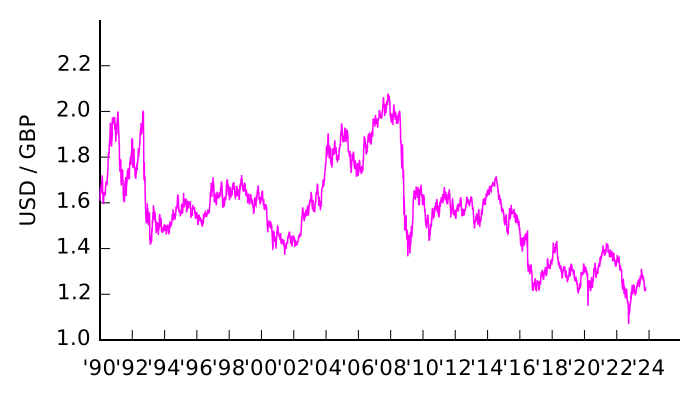
I think that there will be many questions about what the rate of exchange in Ukraine is. When we did the last study, there was a 28:1 exchange rate. Today, it is 42 to 1 The exchange rate has also changed drastically. He says, “We don’t even know how it will look after the war.”
However, the biggest challenge may come from labour.
He says that skilled workers like electricians, mechanics and welders will be highly in demand as Ukraine recovers. This could put upward pressure on salaries.
But the iron ore price outlook provides a balance.
When we did the last estimate, we used an iron ore long-term price of $62 per ton. Iron ore is not much lower than $90 in the last five years, according to me. He says that the majority of iron ore is above $100.
UBS forecasts that the average iron ore price will be around $100 per tonne in 2025. This is expected to drop to about $95 in 2026, and then to approximately $90 in 2027.
Interest rates on financing after the Anglo-American Deal and US-Ukraine Mineral Law
Black Iron’s prospects for financing were significantly boosted when Anglo American, a mining giant, agreed to finance 15.5% of Shymanivske’s project construction costs.
“Anglo American has committed to funding 15.5% of construction costs for the project. They’re also one of the largest mining companies on the planet. “Having them as anchor investors just shows the quality of this project as an investment,” Simpson says.
The US-Ukraine Minerals Development Act, he said, will increase interest in Ukraine from international financial institutions and export credit agencies. This will likely mean that many sources of low-cost funding will be available for this project.
He said that “there will be many people who are watching this project, because it is going to serve as a kind of roadmap for other developers.”
Simpson didn’t elaborate on the question of whether US entities have reached out to the project since the signing, but he did say that the company has begun having discussions in this regard.
Simpson took part in the panel at the Export-Import Bank of the USA’s annual conference last month to discuss how private capital can be mobilized for the reconstruction and recovery of Ukraine.
Steel prices are down due to tariffs, but the Ukraine reconstruction is expected to push up iron ore and steel prices
Simpson spoke out on geopolitical matters, notably trade tensions sparked by US tariffs.
Canada has suffered a lot, with its leaders expressing their anger at this move.
The US President Donald Trump issued an executive order last week that doubled the tariffs for steel and aluminum imports, from 25% to 50 percent.
This new order is already in effect.
The biggest impact of steel tariffs on iron ore is the increase in direct duties. Simpson stated that the global steel price has dropped as a result of this.
Simpson stated that the outlook for iron ore would also be influenced by when the conflict in Ukraine is over. This is because China is the biggest consumer of steel.
Steel and iron ore will rise in price when the war in Ukraine is over.
In the six-to-12 months to come, the key milestones will include the renewal of the permits that are due to expire after six months.
Simpson added that Black Iron is in discussions with various government agencies to secure low-cost financing once the rebuilding process begins.
As new information becomes available, this post Black Iron: Shymanivske Project Key to Ukraine Recovery; Post-War Steel Demand Boosting Prices may be updated.